
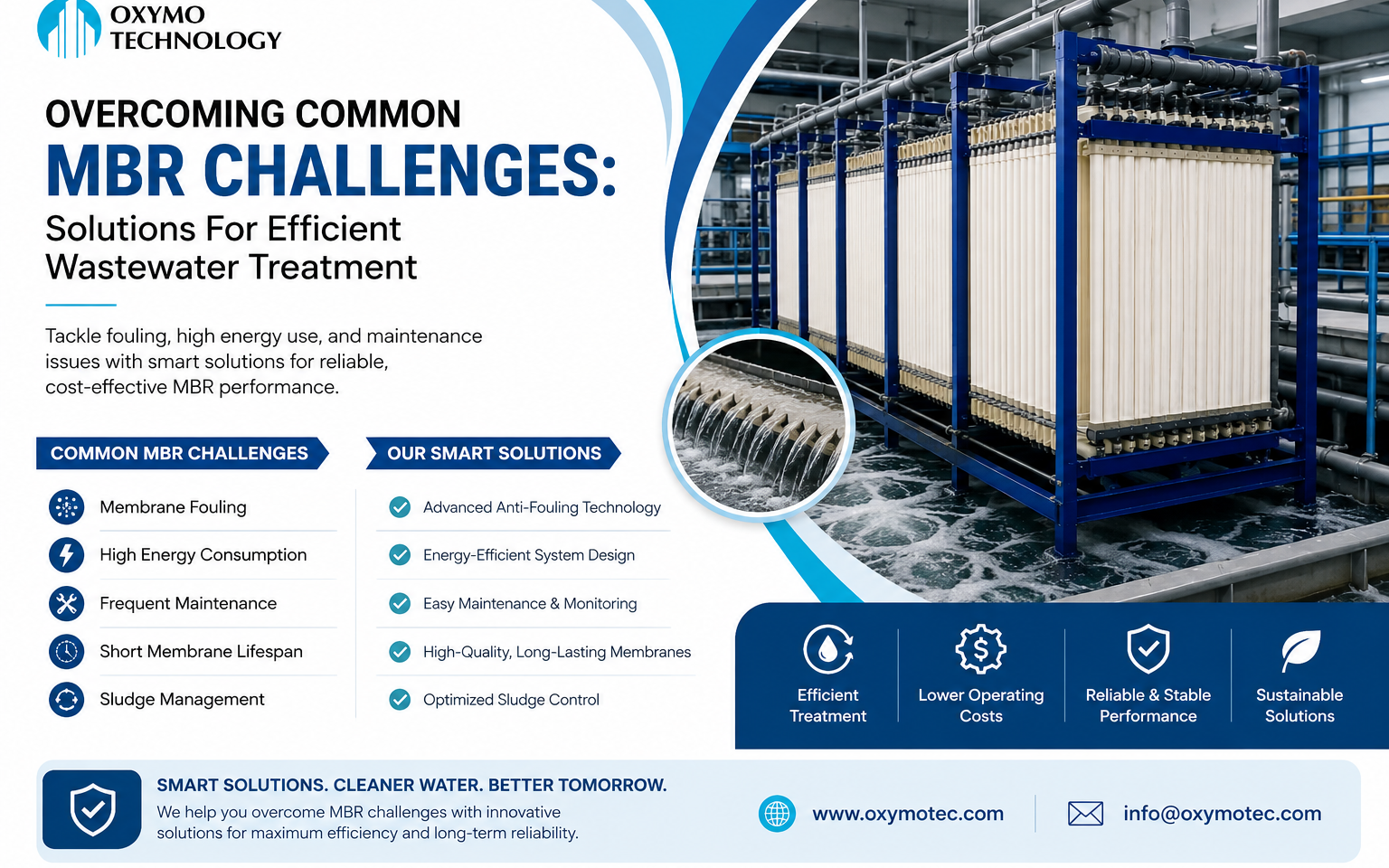
Overcoming Common MBR Challenges: Solutions For Efficient Wastewater Treatment
MBR wastewater treatment has completely changed the way industries deal with their wastewater. It combines a biological treatment process with membrane filtration and results in higher quality effluent compared to the classic treatment methods. Yet, like any other technology, MBR systems have a few disadvantages, like fouling, high energy requirements, and complex operation, which may even result in higher costs. The great thing? Most of the problems that are cropping up during the use of MBR technology have their solutions that are not only worked out but also very practical. Knowing the root causes is half the battle since you can prevent the problem from escalating to a costly matter. In this article, we will discuss the major MBR problems and the possible ways to solve them.
What Is MBR Wastewater Treatment?
A membrane bioreactor (MBR) is a combination of an activated sludge process and membrane filtration. MBR systems separate treated water from the sludge by filtering it through micro- or ultrafiltration membranes rather than gravity settling tanks.
This results in:
- Higher-quality effluent
- Smaller physical footprint
- Improved control of biological processes
- Robust output despite fluctuations in inputs
MBR systems are used throughout a wide range of industries, such as food processing, pharmaceuticals, textiles, and municipal wastewater treatment. They are particularly useful in water reuse applications.
Challenge 1: Membrane Fouling
Why It Happens
Fouling is the most frequent problem in MBR wastewater treatment. It happens when particles, biofilm, or scale block or coat the membrane. The membrane’s flow rate decreases over time, and more energy is required to force water through the membrane.
Fouling can be categorized into three groups:
- Biological fouling: microbial growth on the membrane
- Organic fouling: dissolved organic matter buildup
- Inorganic fouling (scaling): mineral deposits of calcium, magnesium or iron
Practical Solutions
- Optimize aeration: Coarse bubble aeration near membranes creates turbulence, reducing particle adhesion.
- Regular backwashing: Periodic flow back in the membranes removes loose deposits prior to hardening.
- Chemical cleaning cycles: Use citric acid to address scale and sodium hypochlorite for biological fouling on a scheduled basis.
- Control MLSS: Maintain MLSS between 8,000 and 12,000 mg/L to minimize fouling pressure.
- Pre-treatment screening: Fine screens before the membrane zone filter out fibrous materials that accelerate fouling.
Challenge 2: High Energy Consumption
Why It Happens
MBR systems typically consume more energy than conventional activated sludge systems. The primary causes are membrane aeration, sludge pumping, and high recirculation flows.
For industrial operators, up to 60% of the total operating cost for an MBR can be attributed to energy costs, making optimization a primary concern.
Practical Solutions
- Intermittent aeration: Run aeration intermittently rather than continuously. Research indicates that this can reduce energy consumption by up to 20-30% without adversely affecting effluent quality.
- Variable speed drives (VSDs): Use VSDs on blowers and pumps to optimize energy use by adjusting the energy output in real time to meet demand.
- Energy Recovery Systems: In some configurations, energy can be recovered from treated water using heat exchangers.
- Process optimization software: Real-time monitoring software can detect energy waste and enable automatic adjustments.
- Right-size your system: overdesigned systems are a waste of energy. Sizing the MBR accurately to actual flow rates eliminates unnecessary power draw.
Challenge 3: Short Membrane Lifespan
Why It Happens
The most costly part of an MBR system is the membranes. Premature failure can result from physical damage, chemical attack, or operational stress. A properly maintained membrane will last for a period of 7 to 10 years. Poor maintenance can reduce this to fewer than 3 years.
Practical Solutions
- Use the manufacturer’s cleaning procedures: Cleaning with overly strong chemicals degrades membranes faster than fouling itself.
- Monitoring Transmembrane Pressure (TMP): A sudden increase in TMP is a sign of stress. Responding early can prevent irreversible damage.
- Avoid dry running: Membranes should never be exposed to air when dry. Correct shutdown procedures are critical.
- Verify chemical compatibility before any maintenance cleaning.
- Periodic integrity testing: Pressure decay tests detect micro-cracks prior to complete membrane failure.
Challenge 4: Sludge Management Issues
Why It Happens
Careful handling of sludge is essential in MBR wastewater treatment. High MLSS increases viscosity, reducing oxygen transfer efficiency and raising fouling rates. However, too low MLSS will have a negative effect on biological treatment.
Practical Solutions
- Optimize sludge retention time (SRT): An SRT of 15–30 days balances biological activity with manageable sludge volumes.
- Regular sludge wasting: Regular removal of excess sludge prevents MLSS from rising above operating limits.
- Biological additives: Some microbial inoculants help to reduce sludge bulking and enhance settleability.
- Dewatering equipment: Efficient centrifuges, or belt press systems, decrease the amount of sludge handling in the downstream treatment process.
Challenge 5: Operational Complexity
Why It Happens
Membrane bioreactor (MBR) installations require much more hands-on management than conventional ones. Several parameters, TMP flux, DO, MLSS, and pH, have to be checked by the operators simultaneously. Quite often, minor mistakes result in serious damages when the staff is either untrained or the system is not sufficiently automated.
Practical Solutions
- Invest in SCADA systems: Supervisory control and data acquisition systems give up-to-date data and warning messages.
- Operator training programs: Regular upskilling about MBR-specific norms can much reduce the incidents of human errors leading to breakdowns.
- Standard operating procedures (SOPs): Written and plainly explained SOPs for starting, stopping, and servicing offer a prelude to success.
- Remote monitoring: IoT gadgets with in-built sensors help in adjusting the critical parameters even without being physically present.
Common MBR Challenges and What Causes Them
It is helpful to understand what usually fails in MBR wastewater treatment systems before turning to solutions.
| Challenge | Root Cause | Impact |
| Membrane Fouling | Organic and inorganic deposits on membrane surface | Reduced flux, higher energy use |
| High Energy Consumption | Excessive aeration or pumping requirements | Increased operating costs |
| Membrane Damage | Physical stress, chemical incompatibility | Short membrane lifespan |
| Sludge Management | High mixed liquor suspended solids (MLSS) | System overload and downtime |
| Operational Complexity | Poor monitoring or untrained staff | Inconsistent performance |
Best Practices for Long-Term MBR Performance
Here are some long-term measures you can instate to keep your MBR wastewater treatment system working at its best:
- Plan preventive maintenance rather than waiting for something to break down.
- Keep track of your main indicators on a weekly basis and compare them with the past data.
- Carry out a thorough system inspection once a year, which should also include membrane integrity tests.
- Choose well-trained suppliers who will also provide you with regular technical support.
- Keep a log of every cleaning cycle, chemical dosing, and any operational changes.
By managing your equipment proactively, you not only reduce your downtime but also prolong the life of your equipment and have a better handle on your operating costs.
Conclusion
The MBR wastewater treatment processes produce high-quality effluent under good operational conditions, although some problems can arise, like high energy requirements, membrane fouling, increased amounts of sludge, and membrane aging. These can be addressed by scheduled inspection, cleaning, and optimal running conditions. The key areas for minimizing unexpected downtime are regular performance checking, training for operational staff, and preventive maintenance. Having a comprehensive maintenance schedule will also help in extending the life of membranes and in reducing the overall cost of operation soon. OXYMO Technologies offers reliable MBR solutions for industrial companies by providing not only the most promising advanced wastewater treatment systems but also technical knowledge and continuous assistance to run a plant in a low-cost, efficient, and sustainable way.
FAQs
What is the biggest challenge in MBR wastewater treatment?
The main problem is membrane fouling, which reduces efficiency, requires more energy, and can decrease membrane life if not controlled.
How often should MBR membranes be cleaned?
Typical cleaning occurs weekly or bi-weekly, and for more thorough recovery, deeper cleaning should be carried out every 3–6 months, depending on the operating conditions.
How long do MBR membranes last?
With good operation and cleaning, most MBR membranes can last 7–10 years, although poor operational and cleaning practices can significantly reduce this.
Is MBR wastewater treatment suitable for industrial use?
Yes. MBR systems are applied in multiple industries and generate high-quality effluent that complies with discharge and water reuse standards.