
How to Optimize MBR Wastewater Treatment Systems
Water is one of the most valuable resources on earth. As industries expand, the pressure is increasing to treat wastewater properly and efficiently. MBR wastewater treatment systems have become the go-to solution for businesses that need high-quality effluent, compact footprints, and regulatory compliance. However, the installation of an MBR system is not the entire solution. The true challenge is maintaining it optimized – day after day, year after year.
In this blog, we explain exactly how to optimize your MBR wastewater treatment system. You will discover what is impacting performance, what parameters to track, and what the most common pitfalls are that increase costs and shorten membrane life.
What Is an MBR Wastewater Treatment System?
A membrane bioreactor (MBR) is an integrated process that integrates biological treatment with membrane filtration. It eliminates the need for a traditional secondary clarifier by physically filtering out bacteria, suspended solids, and pathogens with a membrane module. The result? Clean, reuse-ready effluent that complies with strict discharge criteria — even with a smaller footprint than traditional systems.
MBR wastewater treatment systems are widely used in:
- Municipal sewage treatment
- Food and beverage processing plants:
- Pharmaceutical manufacturing
- Textile and dyeing industries
- Hotel and hospitality wastewater management
Why Optimization Matters More Than Installation
Facility managers often spend more to install MBRs and then forget about the maintenance needed to keep them running efficiently. An unoptimized MBR system can suffer from the following:
- Rapid membrane fouling
- Increased energy consumption
- Higher chemical cleaning costs
- Shorter membrane lifespan
- Poor effluent quality
Optimization is not a one-time task. It is an ongoing activity that involves keeping a check on all the elements of the system, making adjustments, and keeping it running. If an MBR system is properly designed, it works at optimum performance for years.
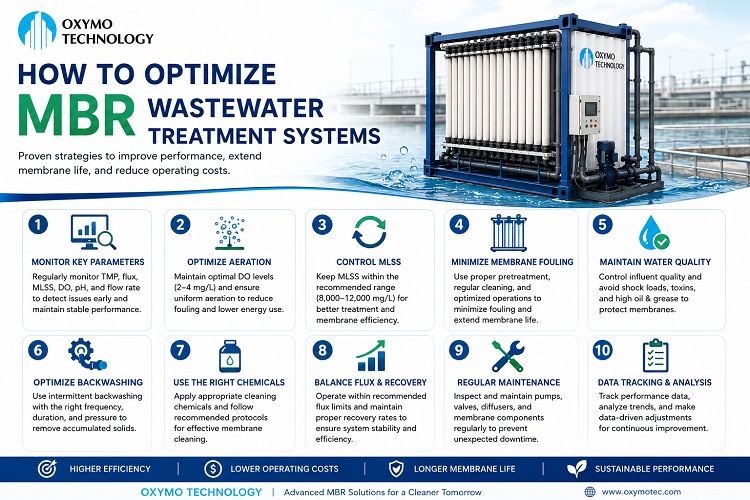
Key Strategies to Optimize MBR Wastewater Treatment Systems
1. Control Membrane Flux to Prevent Fouling
Membrane fouling is the number one enemy of any MBR system. It is a process where particles, biofilm, or colloidal material form on the membrane surface, which causes resistance to build up and diminishes permeate flow. The best way to avoid fouling is to ensure that the process is conducted below the critical flux, which is the point at which fouling begins to increase rapidly. When operating below this level, transmembrane pressure (TMP) remains low and stable, which means membranes stay cleaner for longer.
Best Practices for Membrane Flux Management:
- Regularly monitor TMP values as an early fouling indicator
- Prevent abrupt increases in flux and associated stress to membrane surfaces
- Maintain feed water quality within acceptable limits
- If there are online flux monitoring systems, use them to get alerts in real time.
2. Optimize Aeration for Energy Efficiency
Aeration is an essential component of MBR systems and plays two important roles: providing oxygen to the biological process and providing shear forces to keep membrane surfaces clean. However, it is also the single biggest energy consumer in the system — often accounting for 50–60% of total energy use, depending on system configuration. One of the quickest ways to reduce operating costs is to optimize MBR aeration control. Consider these strategies:
- Use intermittent aeration cycles instead of continuous blasting
- Use variable frequency drives (VFDs) on blowers for load-based control.
- Regularly adjust diffusers to provide even air distribution.
- Match aeration intensity to actual organic load, not design maximums
With proper aeration optimization, energy usage can be cut by 20 to 30% while maintaining the same biological and membrane performance.
3. Maintain Optimal MLSS Concentration
Mixed Liquor Suspended Solids (MLSS) represent the concentration of active biomass in the bioreactor. It is important to get this right both for the biological treatment and for the performance of the membrane. If the MLSS is too low, then there is poor organic removal. If it is above this, viscosity will rise, which will have an adverse effect on oxygen transfer efficiency and will speed up membrane fouling.
The optimal MLSS range for most MBR systems is typically 6,000–15,000 mg/L, though a common operating target of 8,000–12,000 mg/L is used for many municipal and industrial applications. The ideal range depends on the membrane type, system configuration, and influent characteristics. MLSS should be monitored daily, modifying the sludge wasting rate in order to maintain the MLSS within this range.
4. Implement a Rigorous Chemical Cleaning Protocol
Even with good operational controls, over time, membranes become irreversibly fouled. Chemical cleaning can be effective in restoring permeability and can extend the life of the membrane if performed properly.
In the MBR systems, there are two types of chemical cleaning:
- Maintenance cleaning (CIP-in-place): routine cleaning (weekly, bi-weekly) using lower levels of chemical solution to reduce fouling buildup.
- Recovery cleaning (intensive CIP): If TMP has increased substantially, the cleaning process will be used with more concentrated chemicals to restore levels of TMP performance.
Sodium hypochlorite (NaOCl) is usually the chemical of choice for treating organic fouling and biofouling. Citric acid or oxalic acid is typically the acid used for inorganic scaling. Sometimes hydrochloric acid is also used, but that depends on the type of scale. Please follow the instructions of the manufacturer when determining dosage and contact time.
5. Manage Sludge Retention Time (SRT) Carefully
Sludge Retention Time (SRT) is the average time biological solids remain in the system. The SRT in an MBR system is generally longer than that of a conventional activated sludge system, leading to higher degradation and more aged and stable sludge.
Major considerations for MBR sludge handling:
- Longer SRT = better effluent quality, but increased viscosity and possible membrane fouling.
- Shorter SRT = less fouling tendency, but may reduce biological efficiency.
- Make adjustments to SRT as a function of influent load changes and seasonal changes
- Monitor sludge volume index (SVI) for settleability and filterability
6. Monitor System Performance with Smart Instrumentation
You cannot optimize what you cannot measure. Smart monitoring and SCADA (Supervisory Control and Data Acquisition) integration are huge advantages for modern MBR wastewater treatment systems.
Parameters to be monitored constantly:
- Trans-membrane pressure (TMP)
- The dissolved oxygen (DO) levels are measured.
- MLSS concentration
- The values of the permeate flow rate and flux
- pH and temperature
- Effluent turbidity and quality
The problems are easily spotted by the operators as and when they arise, thus helping avoid costly breakdowns. Remote monitoring is available on many modern membrane bioreactor systems, especially useful where these plants are scattered across different industrial sites.
MBR Optimization Quick Reference Table
| Optimization Area | Key Action | Expected Benefit |
| Membrane Flux | Operate below critical flux | Reduce fouling & extend membrane life |
| Aeration | Use intermittent blasting schedules | Lower energy use by 20–30% |
| MLSS | Maintain 8,000–12,000 mg/L range | Stable biological performance |
| Chemical Cleaning | Follow the CIP schedule consistently | Prevent irreversible fouling |
| Sludge Retention | Adjust SRT based on load | Improve effluent quality |
| Monitoring | Use real-time sensors & SCADA | Early fault detection |
Common Mistakes That Hurt MBR System Performance
Even the more advanced operators make mistakes that silently impact system performance. These are the most common, and here’s how to avoid them:
- Running above critical flux without monitoring: Always monitor TMP trends and establish automatic alerts.
- Avoid regular chemical cleanings: Cleaning in advance is a lot cheaper than replacing the membrane.
- Not considering influent variability: Systems need to be adjusted when there is a seasonal or process change in feed quality.
- Undersizing blowers for peak loads: Design aeration systems for peak demand, not average conditions.
- Poor pre-treatment: Hair, fibers, and large solids should not be sent to membranes.
Benefits of a Fully Optimized MBR Wastewater Treatment System
If your MBR wastewater treatment system is operating optimally, the results are tangible and substantial:
- Lower operational costs from reduced use of energy and chemicals.
- Longer membrane life (typically doubling or tripling replacement periods)
- Consistently high effluent quality for safe discharge or reuse
- Improved compliance with the regulations and reduced the risk of permit violations
- No downtime and fewer emergency maintenance calls
- Reduced risk of system failure due to superior reliability and performance
Conclusion
Optimizing an MBR wastewater treatment system is critical for maximizing performance, minimizing operating costs, and maximizing membrane life. Stable operation and high-quality effluent can be achieved through effective control of membrane flux, aeration rates, MLSS level, and cleaning schedules. Organizations that most effectively utilize MBR technology consider optimization as an ongoing process. Consistent monitoring and predictive maintenance enhance efficiency, reliability, and compliance in municipal and industrial wastewater treatment systems. Whether you are running a municipal plant, a food processing plant, or an industrial facility, OXYMO Technologies can assist you in optimizing system performance. Our experts offer real solutions to cut costs, enhance treatment results, and maximize the value of your wastewater treatment investment.
FAQs
What causes membrane fouling in MBR wastewater treatment systems?
Membrane fouling is caused by the accumulation of suspended solids, biofouling, and colloidal fouling on the membrane surfaces, as well as by high MLSS, the lack of aeration, and operation beyond the critical flux.
How often should MBR membranes be chemically cleaned?
The maintenance cleaning is usually done on a weekly or biweekly basis, and intensive recovery cleaning is done monthly or every 3-6 months, or as needed when TMP levels are critical.
What is the ideal MLSS concentration for an MBR system?
The typical operating target is 8,000–12,000 mg/L for most applications, though the optimal range can extend from 6,000 to 15,000 mg/L depending on membrane type, system design, and influent characteristics.
Can MBR wastewater treatment systems handle variable organic loads?
MBR systems can handle pulsing organic loads, as long as the aeration, sludge retention time (SRT), and sludge wasting rates are adjusted accordingly.