
10 Essential Facts About MBR Membranes
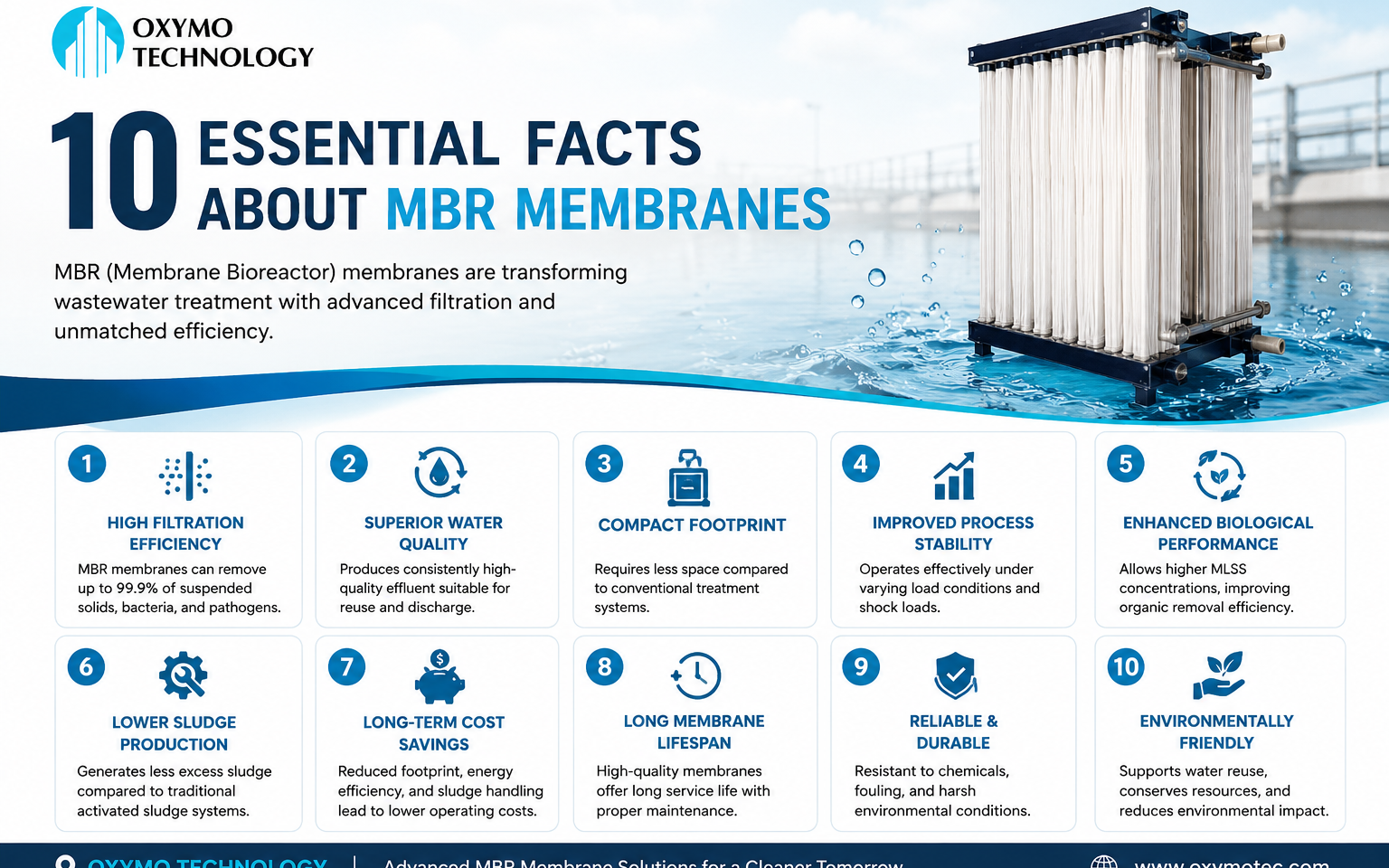
Clean water is no longer a given. As industries grow and regulations tighten, the pressure on wastewater infrastructure keeps rising. That is how MBR membrane technology has become a mainstream solution. Today, MBR systems are the core of high-tech wastewater treatment—providing biological treatment combined with physical filtration to produce effluent quality that older treatment systems are unable to achieve. Whether you are in food processing, pharmaceuticals, municipal utilities, or the heavy chemical industry, you will find a solution here. In manufacturing, understanding how this technology works can directly impact your bottom line. This article breaks down the 10 essential facts you need to know before making any decisions about MBR membrane systems.
Fact 1: What Exactly Is an MBR Membrane?
MBR membrane technology is a combination of two well-established technologies: biological treatment and membrane filtration. The biological side of the treatment employs microorganisms to decompose the organic material in the wastewater. The membrane side is replacing the secondary clarifier of a conventional activated sludge process, acting as a physical filter that removes solids, bacteria, and suspended particles. MBR membrane systems are so efficient because of this integration. Membranes separate solids from treated water without depending on gravity settling, and create high-quality effluent in a fraction of the space.
Fact 2: There Are Three Main Types of MBR Membranes
Not all membrane configurations of MBRs are the same. In industry, there are three main types used: hollow fibre, flat sheet, and multi-tubular, each of which has its benefits.
| Membrane Type | Structure | Best For | Key Advantage |
| Hollow Fiber | Bundles of fine tubular fibers | Municipal & large-scale industrial | High surface area, lower operating cost |
| Flat Sheet | Stacked planar membrane panels | Food, beverage & industrial plants | Easy to clean, fouling-resistant |
| Multi-Tubular | Wide-bore tubular channels | High-solids or viscous streams | Handles challenging feed compositions |
The global market for hollow fiber membrane systems currently has the highest market share at around 50.9% of the total market share, driven by their high surface area and low operating expenses. High-solids environments make flat-sheet membrane systems a good option for food and beverage processing.
Fact 3: Submerged vs. Side-Stream — Configuration Matters
Installation of the MBR membrane inside the system significantly influences energy consumption and operation costs. These are two possible configurations: a submerged (immersed) configuration and a side-stream (external) configuration. In an immersed MBR system, the membrane modules are placed in the biological reactor or in a container near the biological reactor. They work at a lower transmembrane pressure and therefore lower energy. This is why submerged configurations are the market leader with approximately 67.9%–77% of market share in 2024 (figures vary across industry analysts). Side-stream systems, however, force the mixed liquor to pass through a membrane module that is located outside the system. They can cope with higher fluxes, but they need a lot more electricity.
For most industrial and municipal systems, submerged MBR system configurations offer the best combination of performance and operating cost.
Fact 4: MBR Membranes Produce Superior Effluent Quality
The quality of the treated water is one of the most important facts about MBR membrane technology. The membrane is physically sized to remove almost all suspended solids, bacteria, and most pathogens from the effluent, with pore size typically in the microfiltration range (0.1–0.4 micron) or the ultrafiltration range (0.01–0.1 micron). The effluent’s quality is frequently sufficiently high to be used for irrigation, industrial cooling, or indirectly for potable water use without requiring further treatment. This makes wastewater treatment membrane systems particularly valuable in water-scarce areas or in industries with strict discharge requirements.
Fact 5: Compact Footprint Compared to Conventional Systems
Space is a limiting factor in industrial applications. Conventional activated sludge systems with secondary clarifiers take up significant land area. An equivalent MBR membrane system typically requires 30% to 50% less physical space.
This compactness is achieved by using higher mixed liquor suspended solids (MLSS) concentrations, frequently between 8,000 and 12,000 mg/L, as opposed to conventional systems with MLSS between 2,000 and 4,000 mg/L. This is a key benefit for manufacturers located in a high-density industrial area or in an urban wastewater treatment plant with restricted space.
Fact 6: Membrane Fouling Is the Primary Operational Challenge
If there is one topic every operator needs to understand about MBR membrane systems, it is membrane fouling. Fouling is the deposition or buildup of particles, biofilm, or dissolved organic material on or within the surface of the membrane, causing flux to decrease and TMP to build up with use.
Fouling is controllable — not inevitable. The main strategies used to control it include:
- Coarse bubble aeration: Air is bubbled under the membrane module to continuously remove foulants.
- Relaxation and backwashing: Periodic stopping of filtration or reverse flow pulses will help to remove material accumulations.
- Chemical cleaning: Planned cleaning with sodium hypochlorite or citric acid will restore permeability of the membrane without damage.
- Pre-treatment optimization: Identifying and removing the right material upstream (screening and grit removal) greatly minimizes fouling load on membranes.
The two most important levers to carefully select and manage for long-term fouling control are the type of MBR membrane material and aeration rates.
Fact 7: MBR Technology Works Across Diverse Industries
Membrane bioreactor (MBR) technology is not limited to municipal sewage treatment applications. Due to its versatility, it can be used in a variety of industries. These are the main applications:
- Food and beverage processing: Dairy, brewing, and meat processing plants have high organic load effluents, which are effectively treated.
- Pharmaceutical and biotechnology: MBR is well suited for pharmaceutical effluent due to the demanding effluent quality requirements.
- Textile and dyeing: MBR systems can easily treat the complex color and organic loads produced by textile operations.
- MBR systems can tolerate high MLSS levels, making them suitable for pulp and paper applications with high effluent volumes and high solids content.
- Oil and gas: Specialized MBR configurations can be used to treat produced water and process water streams that contain complex contaminants.
- MBR systems can tolerate high MLSS levels, making them suitable for pulp and paper applications with high effluent volumes and high solids content.
The municipal wastewater treatment segment accounted for around 63.67% of the total market revenue in 2024 and was the largest application segment in the global market, though some analyst reports indicate that industrial applications are growing rapidly and, by certain measures, now represent the majority share. Industrial demand has been rapidly increasing.
Fact 8: The Global MBR Market Is on a Strong Growth Trajectory
The MBR membrane market has seen consistent growth driven by tightening environmental regulations, increasing water stress, and rising demand for water reuse. The global MBR market was valued at approximately USD 3.8–4.3 billion in 2024 and is projected to grow at a CAGR of 8.0%–8.9% through the early 2030s, with the market expected to reach USD 8–9 billion by 2033–2034. Asia-Pacific is the largest market segment by revenue in 2024, accounting for more than 40% of the market, of which China has a share of approximately 34%. Rapid industrialization in Southeast Asia, combined with stricter effluent standards, is making MBR system deployments increasingly common in the region.
Fact 9: MBR Membranes Reduce Sludge Generation Significantly
The disposal of sludge is one of the highest unaccounted expenses of wastewater treatment. In a conventional activated sludge system, significant quantities of excess sludge must be dewatered, moved to the disposal site, and disposed of — at a cost. MBR membrane systems have much longer sludge retention times (SRT)that push the system toward endogenous respiration, where biomass decays rather than accumulating — significantly reducing net sludge generation.Less sludge equals lower dewatering costs, lower hauling costs, and a low environmental footprint. This is something the facilities need to consider when trying to lower their overall cost of operation — and not just capital.
Fact 10: Integration With Advanced Treatment Is Simple
Among the lesser-known benefits of MBR membrane technology is its compatibility with downstream treatment systems. Because MBR effluent is already of high quality — low in turbidity, virtually free of suspended solids — it is an ideal feed for advanced post-treatment steps such as
- Reverse osmosis (RO): MBR permeate is an excellent RO feed, extending membrane life and reducing fouling in the RO stage.
- UV disinfection: Low turbidity effluent allows UV light to penetrate effectively, requiring far less energy and dose than with conventional effluent.
- Nutrient recovery systems: MBR can also be designed to provide biological N and P removal to recover resources.
This integration feature is a critical component of the membrane bioreactor technology, which plays a key role in the current water reclamation processes and in the new trend of zero liquid discharge (ZLD) that is being desired by regulators and corporate commitments.
MBR Membrane vs. Conventional Activated Sludge: Quick Comparison
| Parameter | MBR Membrane System | Conventional Activated Sludge |
| Footprint | 30–50% smaller | Larger — requires clarifier |
| Effluent quality | Very high (reuse-grade) | Moderate |
| Sludge production | Lower | Higher |
| Energy consumption | Moderate (submerged) | Lower (but tertiary needed) |
| Membrane fouling risk | Yes — manageable | Not applicable |
| Integration with RO/UV | Excellent | Requires pre-treatment |
| Capital cost | Higher upfront | Lower upfront |
Conclusion
The actual wastewater treatment process is transformed by the innovative membrane technology from MBR. It has a small footprint and a good effluent quality and is suitable for water reuse, so it is a popular option for both municipal and industrial waste. With the increasing importance of water conservation and the tightening of environmental legislation, MBR systems are an effective solution to ensure compliance with environmental discharge standards and promote sustainable water management. Organizations can make well-informed investment decisions when they have information on the types of membranes, system design, and fouling prevention strategies. MBR technology is a proven and scalable solution for upgrading existing facilities and planning new treatment projects. OXYMO Technologies offers you professional guidance and cutting-edge solutions on the installation of efficient and high-performance wastewater treatment plants that are suitable for your needs.
FAQs
What is an MBR membrane used for?
MBR membranes are used to remove solids, bacteria, and suspended particles from the wastewater, which results in high-quality treated water for discharge or reuse.
What is the lifespan of an MBR membrane?
The lifetime of most MBR membranes typically ranges from 5 to 10 years or more, depending on operating conditions, wastewater quality, membrane type, and maintenance practices. High-quality hollow fiber membranes under well-managed conditions can exceed this range.
What are the main disadvantages of MBR technology?
The initial investment is higher in MBR systems, and energy use is higher due to the need for aeration to manage fouling.
Which industries use MBR membranes the most?
MBR membranes are widely used in municipal treatment plants, as well as food processing, pharmaceutical, textile, and oil & gas industries.