
MBR vs Conventional Activated Sludge – Total Cost of Ownership Comparison
Your finance team sees a lower price tag on conventional activated sludge and says yes. Your operations team spends the next decade paying for that decision – in sludge disposal bills, chemical costs, and compliance headaches. Sound familiar?
When it comes to choosing a wastewater treatment system, the purchase price is just the opening act. The real story plays out over 15 to 20 years of operation — and that story often has a completely different winner. This guide breaks down the total cost of ownership (TCO) of MBR (Membrane Bioreactor) technology versus conventional activated sludge (CAS) systems so you can make a decision backed by numbers, not assumptions.
Why TCO Is the Only Number That Matters
The primary method used by wastewater treatment facilities to make procurement decisions focuses exclusively on capital expenditure costs. That’s a bit like choosing a car based only on the sticker price while ignoring fuel insurance and maintenance for the next 20 years. The approach creates narrow thinking, which constantly undervalues the actual expenses associated with less expensive alternatives.
OPEX — the day-to-day running cost — typically accounts for 60 to 70% of the total expense over a system’s lifespan. Ignoring it doesn’t make it disappear. It just shifts the pain to your operations budget, year after year.
| 60–70%
of lifecycle cost is OPEX, not CAPEX |
30–50%
higher upfront cost for MBR systems |
8–12 yrs
typical MBR payback period |
$50–100K
avg. annual OPEX savings (mid-size MBR plant) |
Understanding these Two Technologies
It is necessary to have a good idea how these systems are operating in practice before we compare costs.
What is Conventional Activated Sludge (CAS)?
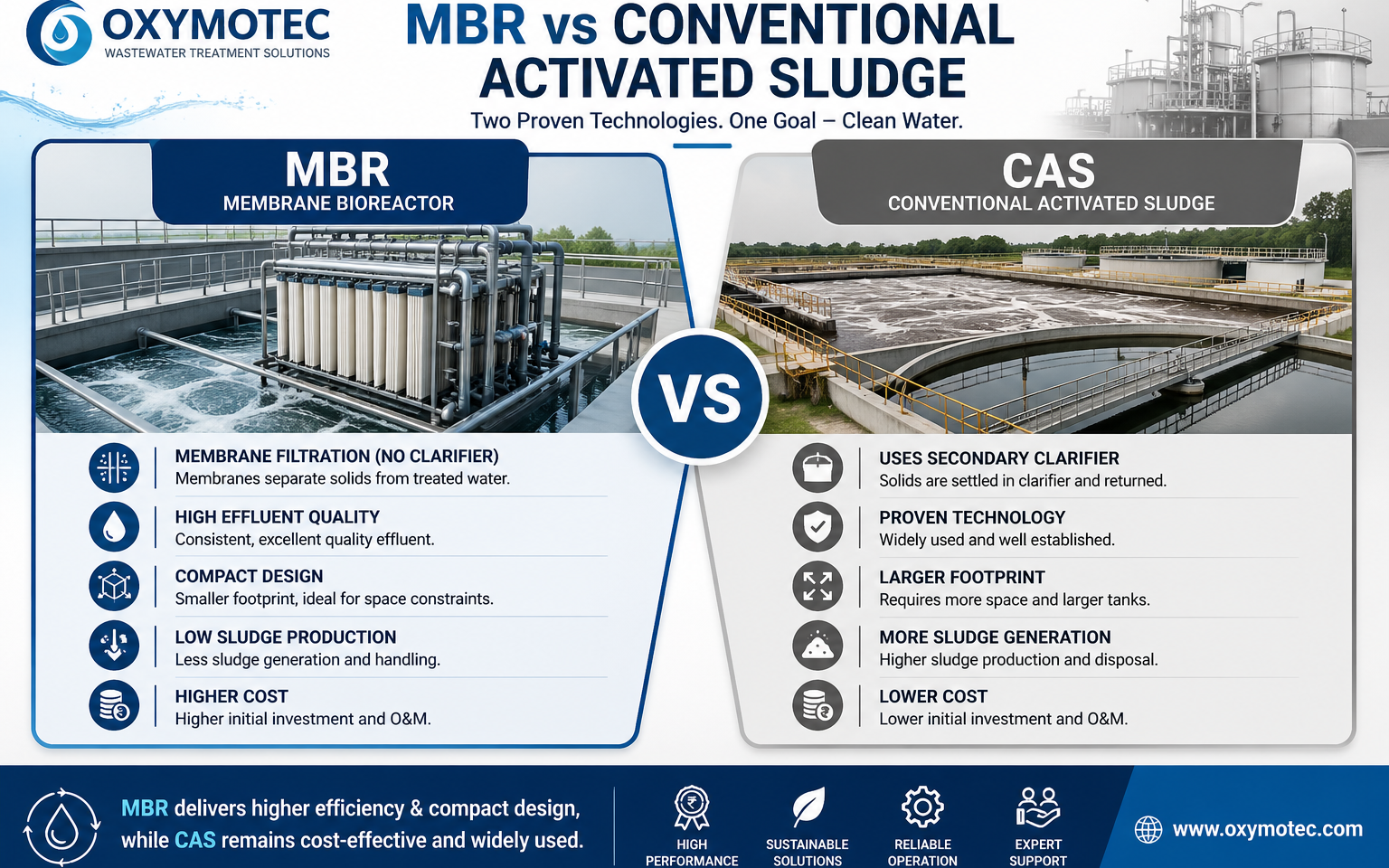
It is the conventional approach undertaken in most treatment plants. It feeds on bacteria to digest waste and after this, separates solids in a settling tank.
It reduces setup cost, requires a large space, and needs additional filtration for reuse.
What is MBR?
MBR (Membrane Bioreactor) is a system that integrates biological treatment and membrane filtration.
It has a compact design, high-quality treated water, and is suitable for reuse applications
What Really Drives Cost Over the Life of the System
Comparing the treatment systems, it is important to look beyond the aspects of surface costs. All factors listed below have a direct impact on long-term financial performance, ease of operation, and scalability.
Capital Cost: The First Decision Point
Conventional Activated Sludge:
Reduced initial cost of equipment but uses large tanks, clarifiers, and other units of filtration, adding to the overall project cost by raising land use and civil construction requirements.
MBR:
It’s more expensive to start up with membranes and controls, but a small footprint saves land, tertiary units are not needed, and the cost of the infrastructure and structures is significantly lower.
Cost of Operation: Where the Actual Difference Lies
Conventional Activated Sludge:
The increase in sludge generation, the use of more chemicals, and constant human surveillance increase the operating costs, and long-term cost management becomes more unpredictable and complicated.
MBR:
Less sludge formation and less reliance on chemicals and automation are the factors that provide stability in the performance and assist in controlling the operating costs since there is a little increased energy use in membrane aeration.
Maintenance and Lifecycle Costs
Conventional Activated Sludge:
Handling of sludge frequently, various parts, and periodic upgrades elevate the maintenance work and unspoken lifecycle expenses, particularly when compliance requirements are elevated as time progresses.
MBR:
Fewer components reduce the risk of breakdown, and membrane cleaning and periodic replacement are required, but it is more predictable and easier to plan and control the lifecycle costs.
Water Quality and Reuse Value
Conventional Activated Sludge:
The quality of effluents is frequently not consistently good enough to be reused, necessitating extra treatment facilities, which costs more and limits the chances of decreasing freshwater use in industrial processes.
MBR:
Delivers high-quality effluent regularly, fit to be reused, such as for cooling and utilities, lessening reliance on freshwater and generating quantifiable cost savings over time.
Space and Scalability
Conventional Activated Sludge:
Requires large land area and complex layouts, making expansion difficult and costly, especially in space-constrained industrial environments or urban locations.
MBR:
The design is compact and modular, which facilitates easy scalability of the design, is suitable in facilities with limited space, or is for businesses wanting to expand to higher capacity over time.
Conclusion: Make the Smarter Long-Term Investment
The issue of selecting systems is not an engineering choice but a financial plan. Standard systems can be alluring should you wish to save money in the short term. But if you want efficiency, sustainability, and long-term cost control, MBR is the smarter choice.
Oxymotech focuses on providing high-technology MBR solutions to the contemporary industry. Our systems save money, enhance performance, and future-proof your operations.
Looking to modernize your wastewater plan? Collaborate with Oxymotech and discover the actual worth of MBR now.
FAQS
Does MBR always provide a lower TCO as compared to CAS?
Not necessarily, but generally yes, particularly in the case of land, sludge expenses, or reuse prospects that are of importance. The benefit increases as time passes.
What is the cost of membrane replacement to MBR operating costs?
Polymeric membranes have a life span of 8 to 12 years. Replacement contributes about 10 to 12 percent of annual OPEX when amortized over the system life, which is a predictable, plannable cost as opposed to the unexpected failures of CAS clarifiers.
Can MBR effluent meet water reuse standards directly?
In most cases, yes. The membrane isolates suspended solids and pathogens to a point that qualifies for irrigation, industrial reuse, and most recharge programs without further treatment.