
How to Clean MBR Membranes – CIP Procedures and Chemical Cleaning Guide
Your MBR system isn’t underperforming because of design flaws. It’s probably just dirty – and there’s a very specific way to fix that. Membrane bioreactor systems are one of the most efficient tools in modern water treatment. But even the best-designed system will slowly lose performance when fouling builds up on the membranes. The solution isn’t always a replacement. More often, it’s a well-executed cleaning protocol – done right, at the right time, with the right chemicals. This guide walks you through everything you need to know about cleaning MBR membranes properly, from understanding why fouling happens to running a complete CIP (Clean-in-Place) procedure step by step.
Why Do MBR Membranes Foul?
Getting to know what you are cleaning before plunging into cleaning processes is a good idea. Fouling in MBR membranes isn’t random. It occurs in layers – and each layer reacts to various chemicals. Organic matter (biofilm, EPS extracellular polymeric substances), inorganic scaling (calcium carbonate, iron, and silica), and colloidal particles lodged in membrane pores with time are the key culprits. Once they get out of control, the transmembrane pressure (TMP) increases, the flux decreases, and the energy expenses increase. The result? A machine that is performing twice the work to produce half the output. It’s there that a structured cleaning program will jump to your rescue – not only in the performance but in the long life of the membrane as well.
Types of Cleaning for MBR Membranes
Fouling is not always a situation that should be treated in the same way. MBR operations usually have three different levels of cleaning, and knowing which one to use and when to use it is half the battle.
- Maintenance cleaning is performed regularly (usually daily or every few days) with low-dose sodium hypochlorite or citric acid. It’s a quick, preventive measure meant to stop fouling before it gets serious. Imagine it as basic maintenance and not thorough washing.
- Recovery Cleaning (CIP) is the tough one. It is done when TMP has increased drastically or when flux has fallen to unacceptable levels. It is done by immersing the membranes in chemical solutions over a long period of time-in most cases, several hours.
- Intensive or emergency cleaning is implemented when the event of severe fouling occurs and the performance is not completely restored by the standard CIP. This can involve longer soak periods, increased chemical levels, or a series of chemical treatments.
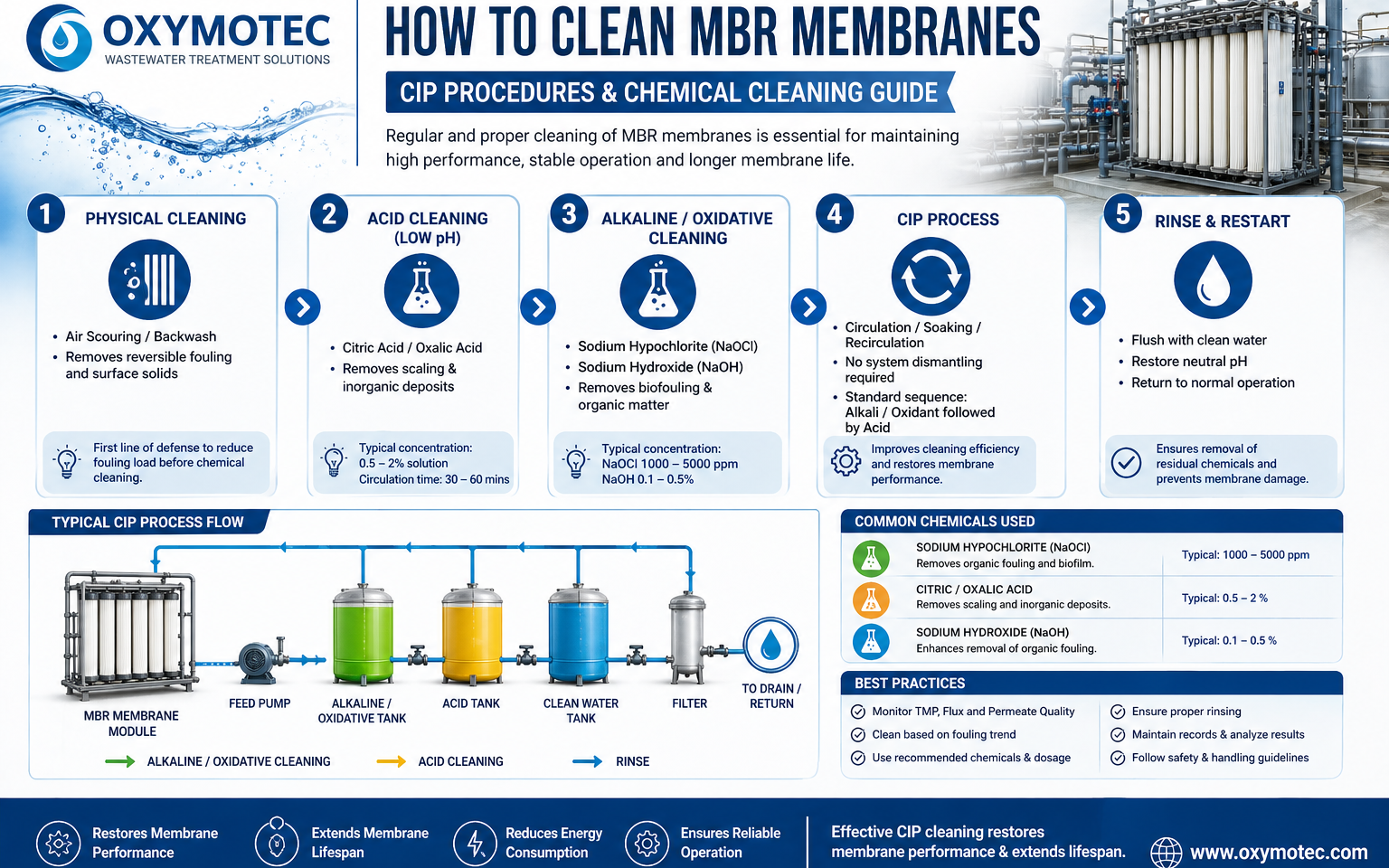
Step-by-Step CIP Procedure for MBR Membranes
An appropriate CIP sequence of MBR membranes generally follows this pattern. Always place the membrane module out of the process flow before beginning and always ensure that the chemicals you use to clean the membrane are compatible with the membrane material you are using.
Step 1 – Physical Backwash or Relaxation.
First, cease permeate flow and relax the membrane. A lot of systems have an automated backwash cycle. This removes foulants that are loosely attached prior to the commencement of chemical exposure.
Step 2 – Alkaline Wash (Organic fouling)
Make a sodium hypochlorite solution, usually 200 to 500 mg/L when using hollow fiber membranes, but always consult your manufacturer specification sheet. Pass the solution through the module and soak it 2 to 6 hours. This effectively targets organic matter, biofilm, and EPS layers.
Step 3 – Rinse
Wash with clean water to get all traces of the alkaline chemical away. This is one of the steps that are frequently underestimated – a partial rinse may disrupt the subsequent step of the chemical reaction or even destroy membranes in the long term.
Step 4 – Acid Wash (Inorganic Scaling)
Make a solution of citric acid (0.2% to 0.3% w/v) or oxalic acid based on the type of scaling. Circulate and soak for 2 to 4 hours. This stage dissolves mineral deposits such as calcium carbonate and iron hydroxide residues of the alkaline wash.
Step 5 – Final Rinse and Back to Service.
Wash with clean water once more and monitor TMP levels prior to going back to use. An effective CIP ought to carry TMP towards its original baseline.
Chemical Selection – What Works and Why
The foulant type determines the chemical to be used. These are some of the most common scenarios:
NaOCl (sodium hypochlorite): Ideal with biological and organic fouling. Recommendation to the majority of MBR cleaning procedures.
NaOH (sodium hydroxide): NaOH is used to remove heavier organic fouling; it may be used in combination with NaOCl in low concentrations.
Citric acid: Its application is effective in scaling calcium, magnesium, and iron. Weaker on membranes than more powerful acids.
Oxalic acid: Applied to iron-based stubborn deposits.
HCl (hydrochloric acid): Sometimes used in the treatment of severe inorganic scaling, but needs close control of pH and must be authorized by the manufacturer of the membrane.
Always verify the pH range your MBR membranes are compatible with – the vast majority of hollow fiber and flat sheet membranes have specific limits, and going beyond them will permanently damage them.
What Is the Frequency of MBR Membrane Cleaning?
The frequency of cleaning is determined by various factors such as the quality of feed water, organic loading, and operating flux. The overall structure will be like this:
- Maintenance cleaning: once every 1 to 7 days.
- Recovery CIP: 3-6 months in normal operating conditions.
- Intensive cleaning: as required depending on TMP trends or flux decline data.
The best method is just to monitor TMP continuously and initiate CIP when TMP increases 15-20 percent over baseline – not at a set calendar time.
Conclusion
Proper cleaning maintains the efficiency of MBR systems and prolongs membrane life. Fouling can occur too frequently, which might be a matter of system design or membrane selection, rather than cleaning.
Oxymotech helps optimize performance with advanced membranes and expert support – reducing cleaning frequency and operating costs.
Call Oxymotech to enhance the efficiency of your system in the long run.
FAQs
What is the difference between CIP and CEB in MBR systems?
CIP is an intensive, offline chemical cleaning, full-recovery. CEB is a fast, online maintenance cleaning performed more commonly.
Can MBR membranes be permanently damaged by fouling?
Yes. Delayed or improper cleaning may lead to irreversible foul or chemical damage.
Is citric acid safe for all types of MBR membranes?
Yes, citric acid is safe with PVDF and polyethylene membranes, but always verify with the manufacturer.
How long does CIP take?
Normally 8-12 hours, with system installation and fouling.