
Water Reuse with MBR – How Industries Achieve a Circular Water Economy
Water is no longer a utility, but it is becoming a strategic resource. The harsh reality of many industries today is that fresh water is scarce, and disposal of wastewater is costly. The actual transformation is occurring as waste is no longer considered waste, but rather a resource that can be used once again. This is where MBR comes and alters the equation.
Rather than treating water and discharging it into the waters, industries are closing the loop. They harvest, recycle, and recirculate water in their systems. And the technology that makes this a possibility is MBR.
What Makes MBR a Turning Point for Water Reuse
MBR (Membrane Bioreactor) is an amalgamation of membrane filtration and biological treatment. However, the true worth is the result, high-quality treated water that can be safely reused.
Compared to traditional systems, MBR produces water with very low impurities. It is also reusable in cooling, cleaning, and even in processes.
This is why industries prefer MBR:
- Delivers quality treated water all the time.
- Takes less space than the traditional plants.
- Reduces sludge production
- Manages variable wastewater loads effectively.
- Easily automated and controlled.
Due to such advantages, MBR is not only a treatment option anymore it is a strategic investment.
How Industries Use MBR to Build a Circular Water System
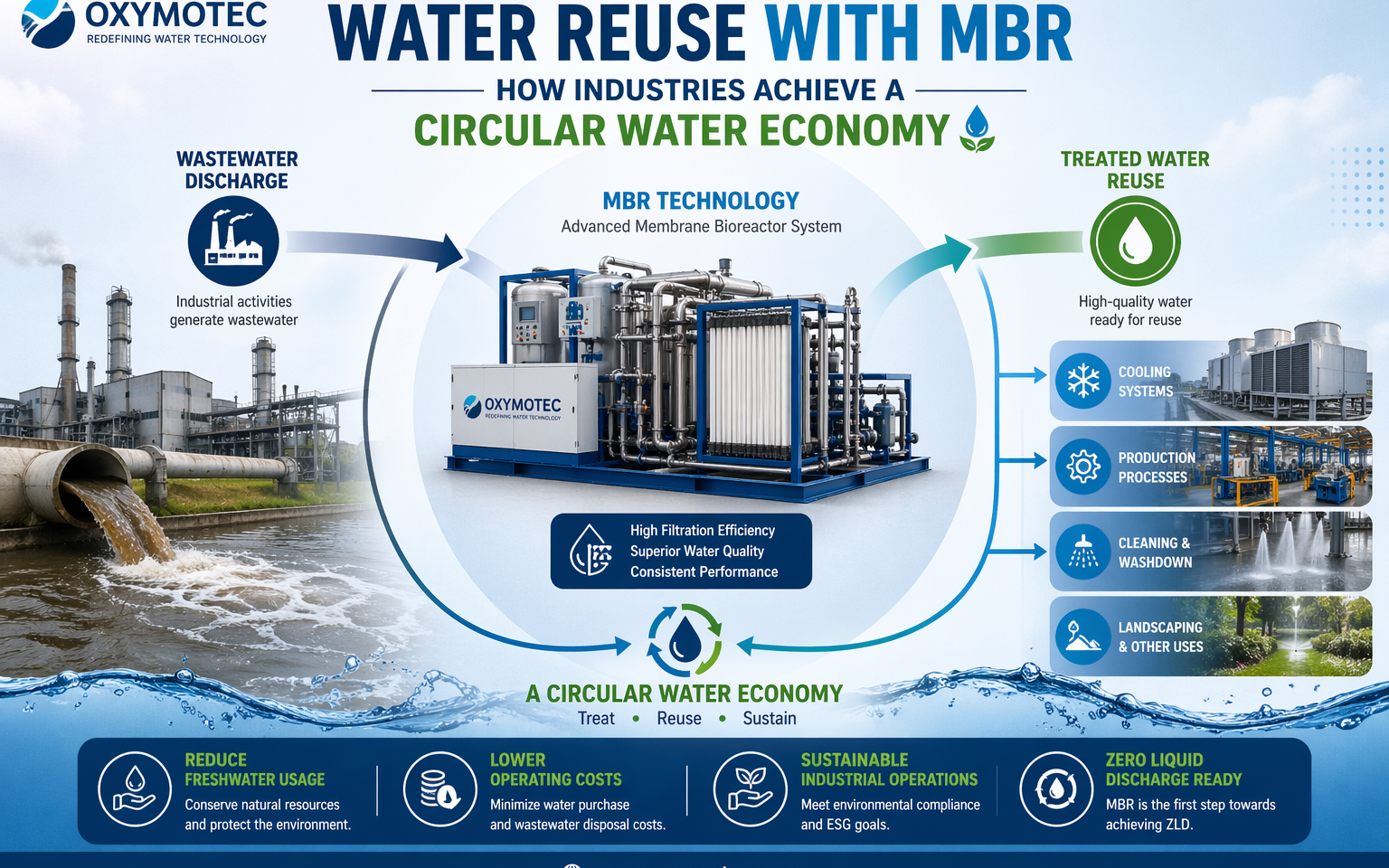
A circular water economy means using water again and again, instead of discarding it after one use. MBR makes this practical and scalable.
Industries are also redesigning their water systems with the consideration of reuse. They do not rely entirely on fresh water sources, but instead treat wastewater with MBR and reuse it within the facility.
Major reuse applications are:
- Makeup water in cooler towers.
- Boiler feed (with additional polishing)
- Washing and cleaning floors.
- Manufacturing process water.
- Landscaping and utility use
This will decrease the amount of freshwater consumed and minimize discharge expenses. More to the point, it protects against water shortage.
Cost Savings and Business Value of MBR
Compliance is the beginning of the decision in the minds of many businesses, but soon it evolves into a cost-saving measure. MBR assists industries to cut down direct and indirect costs.
Compliance is the beginning of the decision in the minds of many businesses, but soon it evolves into a cost-saving measure. MBR assists industries to cut down direct and indirect costs.
Where industries save with MBR:
- Reduce the cost of freshwater purchases
- Low sewage charges.
- Less chemical usage
- Reduced footprint and infrastructure.
- Reduced downtime due to water shortages
MBR systems frequently self-pay over time. They also enhance reliability in operations, which is very essential to large-scale industries.
Sustainability Goals and Regulatory Compliance
Industrial rules are tightening up in the environment. Firms will decrease their consumption of water and minimize the dumping of waste. MBR assists in fulfilling these expectations. MBR helps to achieve sustainability without influencing production by making it possible to reuse water. It also supports the industries to comply with standards easily.
Key sustainability advantages:
- Reduces environmental impact
- Promotes zero liquid discharge (ZLD).
- Enhances the performance of ESG.
- Enhances brand reputation
Organizations that implement MBR technology will gain a competitive advantage because they will maintain compliance with upcoming regulations.
Industries Leading the Shift with MBR
Multiple sectors show evidence of implementing water reuse systems. Industries which operate with high water usage and produce complicated wastewater streams have already adopted MBR technology.
Common industries using MBR:
- Pharmaceuticals
- Food and beverage
- Textiles
- Chemicals
- Automotive manufacturing
The MBR system provides all industrial applications with its adaptable design and operational capabilities, which deliver optimal efficiency under strict water quality standards.
Choosing the Right MBR Partner
Technology alone is not enough. An MBR system works properly only when its design and integration and support services are executed successfully. That’s why choosing the right partner is essential.
A reliable provider ensures that the system is tailored to your wastewater type, capacity, and reuse goals.
What to look for:
- Proven experience in industrial projects
- Custom-designed solutions
- Strong after-sales support
- Focus on long-term performance
The implementation of an efficient MBR system will enable your organization to revolutionize its water management practices.
Summary: MBR Turns Wastewater into Opportunity.
Sectors that consider wastewater as a liability are falling behind. The actual benefit is to convert that wastewater to a usable resource, and MBR can do it. If you want to reduce expenses, ensure water supply, and achieve sustainability requirements, now is the time to take action.
Oxymotech has developed high-tech MBR solutions that are applicable to real-life industrial challenges. Their systems assist you to develop a real circular water economy, from design to execution.
No longer treat water; use it intelligently with MBR. Get in touch with Oxymotech and future-proof your operations.
FAQs
What is MBR, and what is its mechanism?
MBR integrates the biological treatment and membrane filtration to generate high-quality usable water.
Is MBR suitable for all industries?
Yes, MBR is flexible and can be used in industries with different wastewater loads and quality requirements.
Does MBR save on water expenses?
Absolutely. MBR also reduces the amount of fresh water consumed and the costs associated with discharges.
What is the size of an MBR system?
MBR systems are smaller and require less space than traditional treatment plants.