

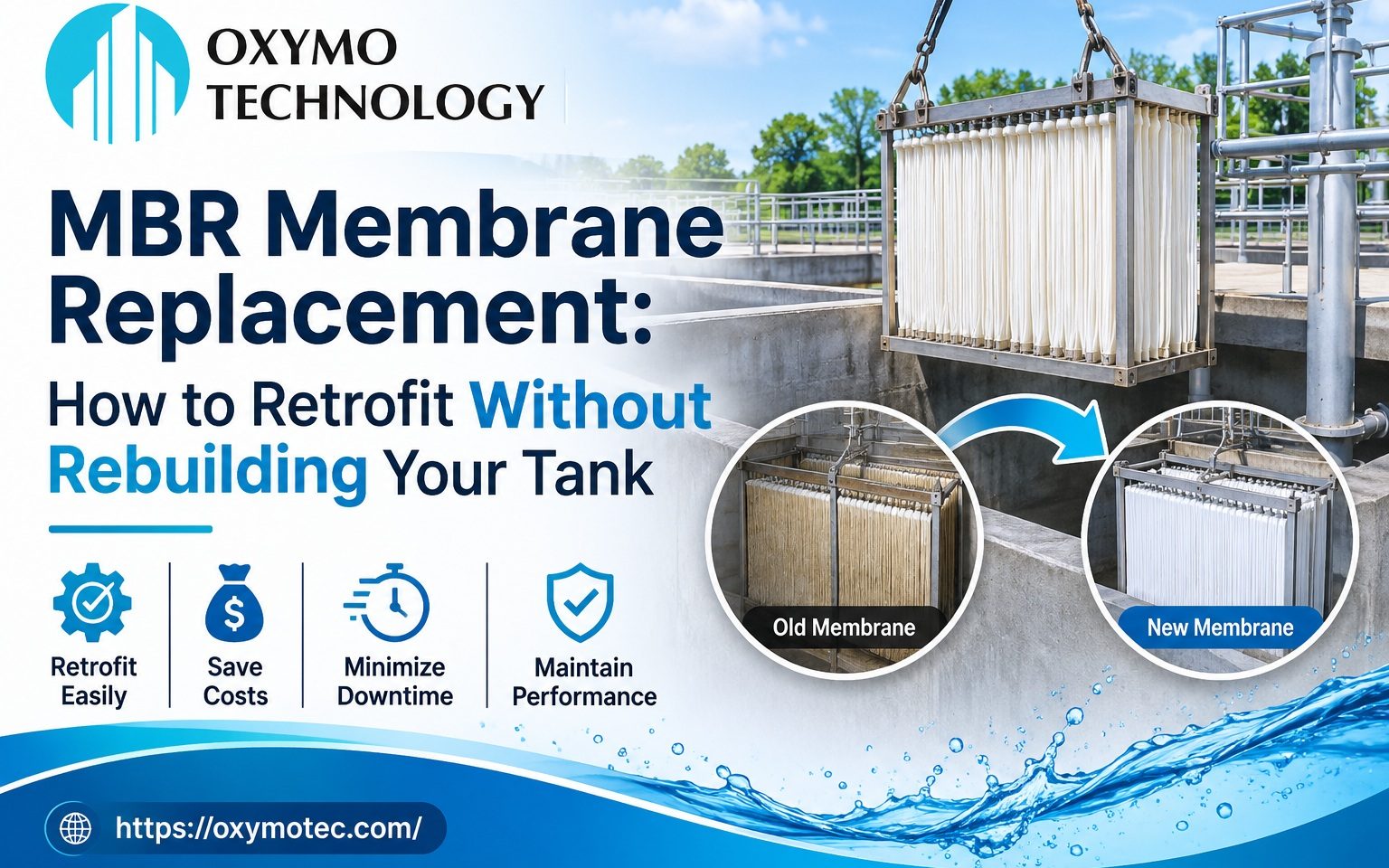
MBR Membrane Replacement: How to Retrofit Without Rebuilding Your Tank
If your membrane is failing, it does not necessarily mean that you have to replace your entire plant. But many teams are instructed to empty the basin and make another one. In many cases, that advice wastes time and money. MBR membrane replacement can often use your existing tank.
A well-designed retrofit also allows the plant to operate while the retrofit is being installed. However, the same problem of fouling can arise again if it is not planned properly. One Virginia utility used its membranes for up to 16 years, beyond the usual 10-year estimate. The team used regular testing to make a decision regarding replacement.
This guide explains how to plan an MBR retrofit without risking plant uptime or overspending. You will learn the warning signs, key checks, and steps to follow. It also addresses how the correct partner can make the work easier.
How to Know It Is Time for Replacement
Membrane wear occurs over time, and initial symptoms are often not obvious. Sometimes minor adjustments in the day-to-day activities occur before a big issue emerges.
Well-maintained MBR membranes typically have an eight- to ten-year lifespan. However, actual service life can vary from plant to plant. In a regional survey conducted in 2019, 7 plants were replaced with membranes after 7-10 years. Another five had been using their membranes for 10 to 12 years without replacement.
A full-scale plant in northern Paris also reported a 46% loss in fiber strength over seven years. This is where it is important to conduct regular checks. Replacement is typically due to broken fibers, reduced permeability, and clogged modules.
Watch your daily operating data for these four warning signs:
- Operating pressure keeps rising: Pressure increases over time, even after a full chemical clean.
- Frequent cleaning: More cleaning cycles = more chemicals = more manpower.
- Permeate becomes cloudy: Broken fibres or damaged seals can contaminate the treated water with solids.
- Flow rate starts to drop: The plant struggles to meet its design flow, especially during peak demand.
If you see two or more of these indications, it might be time to consider replacing your membranes. Early checks will enable you to plan the work prior to further degradation of performance or unplanned downtime of the plant.
How Much Can a Retrofit Save Compared With Tank Reconstruction?
Existing infrastructure and replacement needs determine the total project cost. The use of appropriate tanks can, however, save significant construction costs.
A complete tank rebuild may involve several additional costs. These can include concrete work, excavation, piping, and installation labor.
A retrofit can avoid some of these expenses. It may also reduce project delays and interruptions to plant operations.
| Cost factor | Tank reconstruction | Membrane retrofit |
| Civil construction | Often substantial | Usually limited |
| Existing tank use | May require replacement | Can often continue |
| Installation scope | Wider project scope | Focused equipment upgrade |
| Plant downtime | Depends on the construction plan. | Can be reduced through staging |
| Equipment changes | New system connections | Existing equipment may be reused |
Actual savings will depend on the condition and engineering requirements of the plant. Not every retrofit is necessarily lower cost. Engineers need to weigh both against full cost estimates of the project. Include equipment, installation, energy use and future maintenance expenses.
What to Check Before You Order New Modules
Proper fit and system compatibility are essential for successful MBR membrane replacement. Check these five points with your process engineer before you ask for a quote.
- Tank and frame fit: Check that new modules fit existing tanks and frames.
- Flow capacity: Ensure the new modules can handle the required wastewater flow.
- Biological health: Addressing existing process problems before membrane fouling occurs.
- Air and controls: Check blower capacity, air-scouring cycles, and valve settings.
- Brand compatibility: Ensure that the new modules interface with the current cassettes and connections.
A survey found that two MBR plants had switched to another membrane brand. This indicates that a brand change can be made with design checks. OXYMO Technology can review these factors during a site visit. This helps prevent fit issues and avoid costly modifications.
A Practical Retrofit Plan in Six Steps
A clear sequence makes MBR membrane replacement predictable and helps to safeguard your permit compliance.
- Review existing data such as pressure data, cleaning records, and permeate quality.
- Before sharing drawings with suppliers, measure the basin, frames, diffusers, and piping.
- Address biological problems, including poor screening, grease, and unstable sludge.
- Test new modules next to old ones on one train to demonstrate performance.
- Replace MBR membranes on the remaining trains in planned phases while others keep treating flow.
- Adjust air scouring, cleaning recipes and alarms, and monitor pressure on a monthly basis.
Two new modules were installed in parallel with the old ones at Thélus, France, before a complete change. After a year of stable results, the operator replaced the remaining modules in one day. That proven pilot approach lowers risk before you commit the full budget.
Lessons From Plants That Already Did It
Past MBR projects show what a well-planned membrane replacement can achieve.
- Running Springs replaced its old membranes about 13 years after its first MBR upgrade.
- The project also expanded capacity from 0.6 to 1 MGD and increased energy efficiency.
- For a Belgian transport company, repeated fiber breaks made them replace their first generation modules. The new modules were made from stronger fibers.
- A French beverage plant reduced its chemical consumption by up to 70% by replacing its membranes in 2020.
The supplier attributed this improvement to process changes during the commissioning process.
Make the New Membranes Last Longer
Smart monitoring can extend MBR membrane life and spread costs over time. Loudoun Water ran an annual flux test to track how its membranes aged. At Loudoun Water, replacing every membrane at once would cost between $5 million and $6 million. Replacing it based on data rather than estimates likely saved the plant millions. Three simple habits help any plant stretch the useful life of its membranes.
- Test permeability or flux every year and compare each result with a baseline.
- Screen out hair and fibrous debris that can clog or damage modules.
- Follow supplier cleaning limits, because chlorine can degrade polymer membranes over time.
What Drives the Cost of a Retrofit
Three factors shape the cost of a retrofit more than any others.
- Membrane area needed to meet design flow sets the main equipment price.
- Upgrades to blowers, valves, and controls add cost when old equipment cannot support new modules.
- Phasing affects labor, since each train needs a safe outage window.
Early budgeting for MBR module replacement also helps you avoid emergency purchases. A study of a 200,000 cubic meter per day plant compared two replacement strategies. Model-guided timing reached 6.9 years instead of 5.5 and cut costs 17.5%.
When a Full Rebuild Still Makes Sense
A retrofit is not right for every plant, and honest planning matters. Damaged concrete, such as exposed rebar, needs structural repair before any new module goes in. Large capacity jumps may also exceed what your tank volume and hydraulics can handle. A 2024 AMTA paper reviews process and cost points for adding ceramic membranes to polymeric MBRs. Ask for a site survey so these limits are clear before you commit.
Mistakes That Turn a Retrofit Into a Rebuild
Planning gaps cause many avoidable delays in MBR membrane replacement, so avoid these common mistakes.
- Ordering modules before confirming frame size, manifold position, and tank depth.
- Ignoring the biology and then blaming the new membranes for fouling.
- Keeping old air scouring settings that suit the previous module design.
- Replacing every train at once without first proving results on one pilot train.
Final Thoughts
OXYMO Technology helps plants replace aging MBR membranes without unnecessary civil reconstruction. Before recommending a membrane solution, our team analyzes your tank size, hydraulic loads, aeration, pretreatment, cleaning systems, and operating data.
We concentrate on engineering retrofit practice. This involves identifying the existing basin in which the cassettes will be installed, verifying the air scouring requirement, safe installation planning, and providing operating instructions for commissioning. OXYMO Technology can help you protect your investment and enhance treatment reliability, whether you need a like-for-like replacement or a capacity upgrade.
Ready to replace your MBR membranes without rebuilding your tank? Contact OXYMO Technology to schedule a retrofit evaluation and a membrane replacement plan for your plant.
FAQs
How long do MBR membranes last?
If properly maintained, MBR membranes can serve for about 8 to 10 years. Some modules have even lasted sixteen years at a Virginia plant, with annual testing.
Can MBR membranes be replaced in an existing tank?
Yes. Memrane replacement can often be accomplished in the existing tank. Some of the systems also offer a no-drain installation option. Ask your supplier to confirm what is suitable for your basin/process.
What are the signs that MBR membranes need replacing?
Watch for rising operating pressure, more frequent chemical cleaning, broken fibers, and lower treatment capacity. If two or more of these signs are noticed, begin planning for replacement.
Can you replace MBR membranes with another brand?
Yes, but it needs careful planning. Many membrane modules have their own design. Before picking another brand, inspect the fit of the frame, the capacity for flow, and the control system.
How much does MBR membrane replacement cost?
Cost will vary based on membrane area, plant size, and additions to the controls and blowers. For example, one large Virginia plant estimated a cost of $5 million to $6 million to replace all its membranes.