
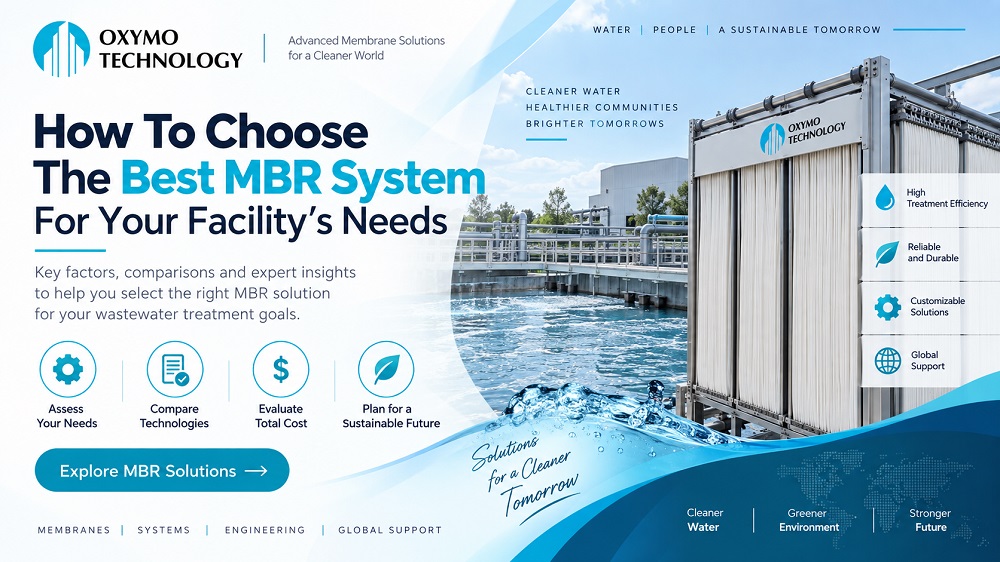
How To Choose The Best MBR System For Your Facility’s Needs
Your plant just failed its discharge test for the third time this year. The fines are adding up, and your operators are tired of dealing with clarifier problems that never seem to end. If this sounds familiar, you are not alone. This is often when an MBR system first comes up as an option.
But not every MBR system is right for every plant. Some units treat textile wastewater with ease but struggle with the high fat found in food plant waste. Others look good on paper but lead to high power bills because no one checked their energy use in detail.
This guide covers the key points to review before you choose an MBR system. These are the points that many sales sheets leave out. By the end, you will have a better idea of how to choose a system that works well and how to avoid one that costs more than it should.
What Makes an MBR System Different From Older Treatment Methods
A membrane bioreactor, or MBR, uses both living microbes and fine filters to treat water in one small system. A standard activated sludge plant needs a separate tank, called a clarifier, where solids settle before the water leaves the plant. An MBR does not need this step. Instead, it uses very fine membranes, often smaller than 0.1 microns, to remove the solids.
This design can produce cleaner water while using less space. It also has fewer parts to manage. That is why many plants with strict discharge limits choose an MBR system. Knowing this key difference can also help you tell useful facts from sales claims when you compare vendors.
Step 1: Study Your Wastewater Profile Before Anything Else
Every good choice starts with real data, not a guess based on a plant that looks like yours. Get recent lab tests and plant records. Do not look only at the basic numbers. Check COD, BOD, TSS, ammonia, nutrients, pH, temperature, and oil or grease. If you run an industrial plant, also check for solvents, salts, and toxic compounds. These can harm the bio treatment step.
EPA guidance for membrane bioreactor design supports this approach. It lists the water coming in, the quality needed at the outlet, and the flow rate as key starting points for any MBR design. They are not extra details.
A drug plant and a dairy plant may have the same daily flow, but they still need very different membrane systems. Be wary of any vendor who gives you a price before asking for your water data. That may mean they are skipping key steps. If you can, ask for a pilot test with your own wastewater. It can find most key issues before they cost you money. It also gives you a stronger hand when you talk terms with the vendor.
Step 2: Match Capacity to Your Actual Flow, Not Just Average Demand
Average daily flow gets most of the focus at first, but it is only part of the story. Your MBR system must also handle peak flow without losing stability. EPA guidance notes that membrane flow can become the main limit during these high-flow times.
Look beyond the daily average. Check flow by hour, changes by season, work plans, planned shutdowns, and any growth plans. If flow changes a lot, you may need an equalization tank before the membrane stage. This helps keep the system steady.
When you compare quotes, ask each supplier to list the average, highest, and peak design flow. Do not accept just one number. This can show that two systems that seem alike are not the same. A system that is too small may put stress on the membranes and cause early failure. A system that is too large may cost more for space and parts you may never need.
Step 3: Compare Membrane Types Before You Commit to One
Average daily flow gets most of the focus at first, but it is only part of the story. Your MBR system must also handle peak flow without losing stability. EPA guidance notes that membrane flow can become the main limit during these high-flow times.
In a submerged system, the membranes sit in the bio tank or a tank next to it. These systems usually work at low filter pressure. They are a good fit for many city and plant wastewater jobs. In an external system, pumps move the mixed water from the bio tank to membrane units placed outside the tank. This setup often uses more power, but the units are easier to reach for checks, cleaning, and repair.
| Membrane Type | Best For | Maintenance Need |
| Hollow Fiber | High flow, moderate solids | Frequent air scouring |
| Flat Sheet | High MLSS, industrial loads | Moderate cleaning cycles |
| Ceramic | Harsh chemical streams | Low, but higher upfront cost |
So, do not choose a system based on price alone. Compare this table with the wastewater data from Step 1. Once you do, the right options will be much easier to spot.
Step 4: Check Pretreatment Before You Get Too Attached to Any Membrane
Pretreatment often gets little focus during sales talks. But it helps stop your membranes from fouling, clogging, and getting damaged. It should be part of the system choice from the start, not added after you pick the membrane.
EPA guidance calls for fine screens just before the MBR membranes. These screens are often 1–3 mm wide. The right size depends on the membrane type and module design your supplier plans to use.
Based on your site, you may need some of these steps:
- Coarse screens to catch large waste and stringy material
- Fine screens to keep small solids away from the membrane modules
- Grit removal if sand or other hard particles enter the plant
- Equalization to smooth out changes in flow or waste strength
- Oil and grease control for wastewater with high fat, oil, and grease levels
If a supplier cannot clearly state what pretreatment its system needs, take a closer look before moving ahead.
Step 5: Factor in Footprint and Installation Realities
Space limits are often the main reason a plant starts to look at an MBR system. Check the land and ceiling space you have. Also check that power, water, and drain lines can reach the site.
Choose early between a plant built on-site, a ready-made unit, and a containerized unit housed in a shipping container. Containerized units work well when site access is hard or you need a fast setup. Ready-made plants may include screens, disinfection, and sludge handling. Plants built on-site give you more ways to fit the design to your needs, but they take more time to start.
Walk the site with your vendor before the layout is set. A drawing may miss key site limits.
Step 6: Calculate the True Cost, Not Just the Sticker Price
An MBR system often costs more at the start than a standard activated sludge plant. But the first price does not show the full cost. Aeration and membrane use can raise your power bill. However, you can save money, pay lower sludge disposal fees, use fewer chemicals, and have smaller tanks.
Ask for a total cost of ownership report that covers at least ten years. The report should be based on actual site information, local power costs, and perhaps typical run times, rather than an industry average. It should list the cost of blower and pump power, cleaning chemicals, spare parts, membrane changes, sludge handling, and routine care. Also ask the supplier to list all costs that are not part of the quote. Additional expenses like this can lead to significant financial problems.
Step 7: Check Fouling Control and Ongoing Maintenance Support
Fouling is one of the main problems with any MBR system. It starts when solids, organic matter, and other waste build up on the membrane. This buildup makes it harder for water to pass through. EPA lists air scouring, chemical cleaning, and back-pulsing as key ways to control fouling.
Ask each vendor how they manage fouling on a daily basis. Discuss how often air scouring is used, what the cleaning-in-place process involves, when rest cycles occur, and how long the membranes are expected to last with your wastewater. Ask how operators will know there is a problem. The system should have alarms, pressure checks, and a clear plan for high pressure or low air flow.
Even a well-made MBR system will not work well if your team cannot run it with ease. The most effective system is the one that suits your employees, knowledge, and workflow.
Step 8: Check Expansion, Redundancy, and Local Support
Your facility may grow, or production needs may change. At some point, one membrane train may also need to come offline for maintenance. A good design should plan for these needs from the start, rather than treating them as future problems.
Ask if the layout can support more membrane modules later. Check if the proposal includes standby capacity or an N+1 setup where needed. Also look at service support. Check membrane supply, spare parts, emergency response, cleaning support, and operator training costs.
A vendor may offer a good membrane, but weak service can still create major problems. Reliable support, fast spare part supply, and quick help can be just as important as the membrane itself.
A Practical MBR System Selection Checklist
| Selection Area | What to Verify |
| Wastewater profile | Flow, BOD, COD, TSS, nutrients, pH, temperature, FOG |
| Treatment target | Discharge limits, reuse quality, nutrient requirements |
| Membrane | Configuration, material, flux range, cleaning method |
| Pretreatment | Screening, grit removal, equalization, FOG control |
| Operation | Aeration, pumps, controls, alarms, monitoring |
| Cost | CAPEX, energy, chemicals, membranes, labor, maintenance |
| Reliability | Redundancy, spare parts, membrane replacement support |
| Supplier | Design support, commissioning, training, after-sales service |
Conclusion
An MBR system selection is not a decision that can be made based on a brochure. You need to review your wastewater data, flow rate, site needs, and long-term costs. It is important for the system to be designed for your specific process and not based on a standard design.
A good supplier should guide you in comparing the different membrane types, energy consumption, cleaners, potential maintenance, and costs. This can help prevent costly changes down the road and select a system that fits your site.
If your facility is ready to move forward, Oxymo Technology can help. Its engineering team can review your wastewater, check the key requirements, and design an MBR system based on your actual site conditions.
FAQs
What factors should I consider when choosing an MBR system?
Consider wastewater quality, average and peak flow, effluent targets, available space, energy use, maintenance needs, membrane life, and vendor support.
Is an MBR system suitable for industrial wastewater?
In most cases, yes. However, it depends on the wastewater composition, biological treatability, loading, pretreatment, and required effluent quality.
What’s the difference between submerged and external MBR?
Submerged membranes sit inside or close to the biological tank. External systems pump mixed liquor to separate membrane modules outside the tank.
How is MBR membrane fouling controlled?
Fouling is controlled through proper pretreatment, air scouring, suitable flux rates, planned cleaning cycles, and regular system monitoring.