
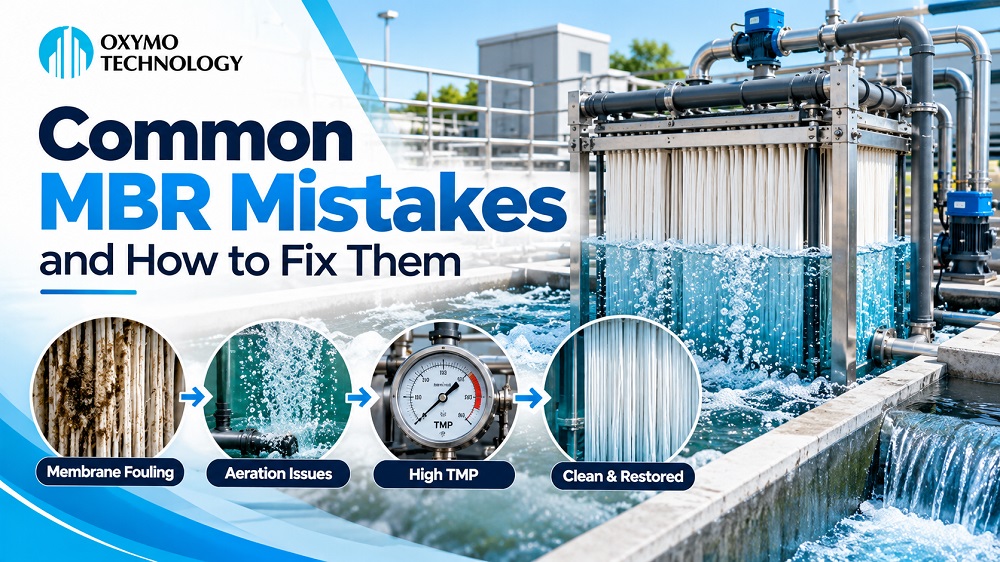
Common MBR Mistakes and How to Fix Them
Something feels off with your MBR system long before the numbers admit it. Flux drops, transmembrane pressure climbs, and cleaning cycles start shrinking week after week. Most operators blame the membrane the moment performance starts slipping. But the membrane rarely causes the problem on its own. It usually reacts to a mistake made somewhere earlier in the process.
Small errors in pretreatment, aeration, or retention time build up slowly. By the time symptoms appear, the fix costs far more than it should have. This guide covers the mistakes we see most often in real MBR operations, backed by published design guidance and manufacturer cleaning data, and shows how to correct each one before repair costs climb any higher.
1. Inadequate Pretreatment and Screening
Many teams see screening as a small step before the main MBR process. But this step can cause major problems if it is not done well. Poor screens let hair, fibers, and other waste enter the membrane tank. This waste can wrap around the hollow fiber membranes and cause “ragging.” When this happens, workers may need to take out the membrane cassette and clean it by hand.
The U.S. EPA lists screening and pretreatment as key parts of MBR design. Screens that are too large or not suited to the waste can lead to early membrane damage. Fine screens smaller than 2 mm can remove most of this waste before it reaches the membrane tank.
- Install fine screens ahead of the bioreactor, not just coarse bar screens
- Inspect screens weekly during the first three months of new operation
- Track clogging frequency so screen wear gets flagged before failures happen
2. Ignoring Early Signs of Membrane Fouling
Membrane fouling rarely leads to a sudden failure. It often builds up over time. First, flow may start to drop as slime and solids collect on the membrane. If the team waits until water quality falls, the fouling may be hard to remove. Organic matter, sticky cell material, and small solids can all add to this layer.
A steady rise in transmembrane pressure (TMP) is one of the best early signs of fouling. This is most clear when the flow rate stays the same. Many cleaning plans call for a chemical clean when TMP rises by about 30 kPa above its normal level. Check TMP every day. A simple daily chart can help you spot small changes early, before fouling becomes an expensive problem for the plant.
3. Getting Sludge Retention Time and MLSS Wrong
Sludge retention time (SRT) is the time biomass stays in the system before it is removed. If SRT is too short, the biology may not settle into a steady state. It may also struggle to treat the waste load. If SRT is too long, mixed liquor suspended solids (MLSS) may rise too high. High MLSS makes the water thicker. It can also make membrane fouling worse. Many plants keep using an SRT set by an old design or past consultant. They do not always check if it still fits the wastewater they treat today.
MBR studies and equipment guides often place a good MLSS range at about 8,000 to 12,000 mg/L. Some systems can run at up to 15,000 mg/L if the membrane design and air flow can handle it. Set SRT and MLSS according to the actual waste load at your plant. Avoid copying values from another facility, since municipal and industrial wastewater can behave very differently. Test MLSS at least twice a week. Regular checks help operators catch changes early, before they affect membrane flow or permeate quality.
4. Depending Only on Chemical Cleaning
Chemical cleaning can bring membrane flow back fast. But using it too often can shorten membrane life. Sodium hypochlorite helps remove organic and biofouling. Citric or oxalic acid helps remove mineral scale. Some operators clean membranes every few weeks because it seems safer than addressing the underlying problem. However, frequent cleaning can mask issues with airflow, SRT, MLSS, or other process conditions.
Use the right chemical and concentration for the type of fouling. Organic or biological fouling is typically treated using sodium hypochlorite at levels of approximately 100–500 ppm free chlorine. Citric or oxalic acid is typically used at around 0.1–0.2% to remove scale. A routine clean takes about 30 – 60 minutes, depending on the type of clean. Deeper recovery cleaning is needed less often, typically every 3–6 months. It uses a stronger solution and a longer soak to help restore membrane flow.
Never mix sodium hypochlorite with acid. Flush the system thoroughly between cleaning steps. Mixing the two can release toxic chlorine gas. Physical cleaning should also be part of a good MBR maintenance plan. Backwashing and air scouring can remove loose solids without using harsh chemicals. Combining physical and chemical cleaning can help extend membrane life.
5. Weak or Uneven Aeration
Aeration does far more in an MBR than supply oxygen to biomass. Coarse bubble aeration scours the membrane surface directly and limits cake layer formation. Systems with poor aeration design let solids settle onto membranes almost undisturbed, which accelerates fouling and raises the frequency of cleaning cycles needed each month. Many plants set aeration rates once during startup and never revisit them.
Reviewing airflow distribution across membrane modules often reveals uneven scouring patterns. Diffusers positioned incorrectly leave some membrane areas exposed and others oversupplied with air. Rebalancing airflow, alongside routine diffuser inspections, keeps scouring consistent across the entire tank.
6. Not Tracking Flux and Transmembrane Pressure
Operators who skip regular flux and pressure monitoring lose their earliest warning signs. A consistent flow that is accompanied by increasing pressure is an early warning sign of trouble long before permeate quality deteriorates. If not monitored on a daily basis, it’s not noticed until your system requires emergency cleaning or parts replacement. The sensors required can be found in many plants, but usually they don’t check what they trigger.
Simple trend charts, updated daily rather than pulled together once a month, catch developing problems weeks before they turn expensive.
Getting Your MBR System Right From the Start
Most MBR mistakes have little to do with faulty equipment or bad membranes. They come from skipped screening steps, delayed monitoring, and SRT or MLSS values set once and left alone. Fixing them doesn’t always call for new hardware. It often just needs better screening, a tighter cleaning trigger, and consistent tracking of flux and TMP trends.
If your plant is dealing with fouling, rising energy costs, or shrinking cleaning intervals, the cause is usually one of the issues above. Oxymo Technology works with industrial and municipal teams to review current MBR setups against these exact failure points and build fixes around the plant’s actual operating data rather than a generic checklist.
FAQs
What is the most common cause of MBR membrane fouling?
Organic matter, biofilms, and mineral scale are common causes of MBR membrane fouling. The issue can be exacerbated by inadequate pretreatment or insufficient aeration. Operators can use regular monitoring to identify fouling early on.
How often should MBR membranes be chemically cleaned?
Chemical cleaning should be based on TMP trends, not only on a fixed schedule. Normal cleaning can be required weekly or monthly based on the system’s performance. More intensive recovery cleanings should be performed every 3-6 months as needed.
What MLSS range works best for MBR systems?
Most systems run well between 8,000 and 12,000 mg/L, with some tolerating up to 15,000 mg/L when aeration and membrane design support it.
Can MBR systems handle industrial wastewater?
Yes. MBR systems can treat many types of industrial wastewater when the system is properly designed. Industrial plants may require higher pretreatment levels, fine screening, and other SRT levels than municipal facilities. The design should be compatible with the wastewater quantity and contaminant type.